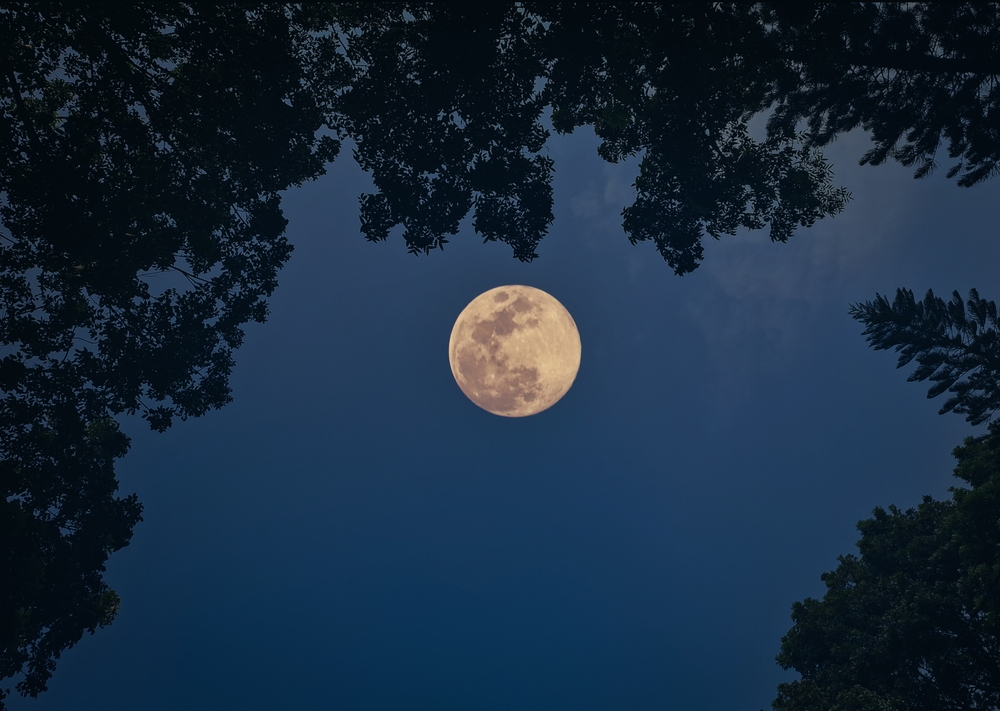
For New York City and nearby states, the last Full Moon of 2025 is on Thursday, December 4, 2025 at 6:14 PM Eastern Time. This December Full Moon often called the Cold Moon will be a spectacular sight. In fact, it occurs near the Moon’s perigee (closest orbital point), making it a supermoon with the Moon appearing about 7-8% larger and brighter than average. Astronomers note that this Cold Moon will be the second-largest full moon of 2025. In the NYC area, expect the Moon to be high in the sky on Dec 4th evening, lighting up the early winter night. We’ll cover the exact timing, what “Cold Moon” means, rising/setting times, best viewing spots around New York, and even tips for photographing this full moon.
Full Moon on December 4, 2025 (the “Cold Moon”)
This month’s full moon is traditionally called the Cold Moon. The name reflects the onset of freezing winter weather in December. According to lunar lore (and the Old Farmer’s Almanac), December’s full moon was called the Cold Moon (Mohawk) or the Long Nights Moon, marking the time when nights are longest and the chill sets in. In practice, New Yorkers should mark the night of Thursday, Dec 4, 2025 on their calendars. On that evening, the Moon will be 100% illuminated at exactly 6:14 PM EST. At that moment it will lie in the constellation Taurus, and it will soon rise from the east. (In Coordinated Universal Time, 6:14 PM EST corresponds to 23:14 UTC.)
Key Facts: December 2025 Full Moon – Date: Dec 4, 2025; Time: 6:14 PM EST. Names: “Cold Moon” (North American tradition). Constellation: Taurus. Supermoon: Yes (near perigee).
The time of 6:14 PM EST on Dec 4th means the Moon will be fully lit in the evening sky (just after sunset). TimeandDate’s lunar calendar confirms “Full Moon on Thursday, 4 December 2025 at 6:14 pm” for New York. (That site also notes this is a Super Full Moon on Dec 4.) TheSkyLive confirms the same: a full moon on “Thursday, December 4 at 23:14 (Europe/London)” which is 6:14 PM EST.
Because the Moon’s orbit is elliptical, this full moon falls just 12 hours after perigee. In concrete terms, on Dec 4 the Moon will be only about 357,218 km (221,966 mi) from Earth (much closer than the ~384,000 km average). This closeness makes the Moon’s apparent diameter about 7.6% larger than average. Astronomers note this is the third of four consecutive supermoons at the end of 2025. All this adds up to a noticeably bright, big-looking Full Moon – a true Cold Supermoon for NYC observers.
When and Where to Look (NY & Surrounding States)
On the evening of Dec 4th, 2025, the Cold Moon will already be above the horizon by sunset. (Sunset in NYC on Dec 4, 2025 is around 4:29 PM EST.) By 6:14 PM when it is exactly full, the Moon will be high in the sky. TimeandDate’s detailed table indicates that on Dec 4 the New York City moonrise actually occurred early that morning (6:52 AM), and moonset will be at about 3:54 PM. In other words, the Moon had already crossed the meridian well before the evening of Dec 4. However, from our evening perspective on Dec 4, the Moon will still be shining brightly overhead. It finally sets just before midnight (around 11:59 PM).
For those who prefer to catch the Moon at rise, consider the next evening (Friday Dec 5). Some guides note that on Dec 5, NYC’s moonrise is about 4:56 PM EST, roughly 25 minutes after sunset, offering a classic moonrise view with the City skyline. (TimeandDate’s data for Dec 5 shows a morning rise at 8:09 AM, so actual times can vary by calculation. In any case, Dec 5 around sunset should also yield a dramatic view of the full moon.) Regardless, on the night of Dec 4–5 the sky will be dominated by the Cold Moon.
Observing the Cold Moon in New York and neighboring states means finding a clear eastward horizon. Any open park or waterfront works well. For example, Liberty State Park (Jersey City, NJ) is famous for its east-facing view of Manhattan. Photographer Brian Youchak raved that Liberty State Park is one of his favorite spots for full-moon shots, with “easy access and great views” of the skyline. From here, the Moon will rise behind Manhattan and even the Statue of Liberty at the right timing.
View of Lower Manhattan from New Jersey (Liberty State Park area). Such open east-facing locations are ideal for photographing the December “Cold Moon” rising over the city.
Other recommended vantage points include Weehawken Waterfront (NJ) and Gantry Plaza State Park (Queens, NYC), both offering wide riverfront views facing Manhattan. In fact, photo guides explicitly list Weehawken and Liberty State Park as prime moonrise photography spots, and note Gantry Park in Long Island City for its unobstructed midtown skyline view. For a real “supermoon” effect, Eagle Rock Reservation (West Orange, NJ) is popular: from this distant hilltop you can use a long telephoto lens to compress the perspective so that the rising full moon lines up with the skyscrapers.
- Liberty State Park, NJ: Open waterfront with clear eastward views of Manhattan. Easy parking and paths make it a top spot.
- Weehawken Waterfront, NJ: Just north along the Hudson; parks like Donnelly or Lincoln Harbor offer skyline views.
- Gantry Plaza State Park (Queens, NYC): East River park in Long Island City facing midtown. Wide lawns let you compose the skyline and moon.
- Eagle Rock Reservation (West Orange, NJ): An elevated park ~20 miles from Manhattan. A telephoto lens here produces a giant-appearing moon behind the skyline.
- Other NYC parks: (Central Park’s meadows, Roosevelt Island, Brooklyn Bridge Park, etc.) – generally any open area with an easterly view.
- Dark Sky Areas: If you can travel farther, mountain or rural spots in NY and CT (e.g. Catskills, Adirondacks) will show the bright Moon against a dark sky.
Wherever you go, try to choose an open, east-facing location. Experts suggest an elevated or unobstructed view of the eastern horizon for the best moonrise experience. This maximizes the visual impact as the bright Full Moon climbs into the sky. For example, if you’re on a rooftop or high hill facing east, you’ll see the Moon appear just after sunset. (And you can use any online moonrise calculator to get the exact time for your spot.)
Photographic Tips for the 2025 Cold Supermoon
Photographing the December full moon over New York can be very rewarding. Here are some tips to capture it well:
- Use a Telephoto Lens (200mm+): To fill the frame with the Moon and city details, a long focal length is essential. For example, a 70–300mm or 200–600mm lens (on full-frame) will let the Moon appear large next to skyscrapers. The blog above recommends at least 200mm focal length to effectively include both the Moon and skyline.
- Mount on a Sturdy Tripod: A tripod is crucial for sharp moon shots, especially at night. It steadies your camera for longer exposures and lets you carefully track the rising Moon. As photographer Erin Donahue notes, “a tripod ensures stability” since the moon moves noticeably fast during moonrise.
- Shoot in Manual Focus: Autofocus can struggle on the dark city plus bright moon. Pre-focus manually (set focus to infinity or on a distant building) and keep it locked.
- Aperture ~f/8: Choose a mid-range aperture. Around f/8 gives a good depth of field for cityscape while still capturing the Moon’s brightness. You can open up to f/5.6 if needed for light, but narrower (f/11–f/16) also works if your lens is sharp there.
- Shutter Speed ~1/125–1/200 s: The Moon is surprisingly bright. Shutter speeds on the order of 1/125 or 1/200 of a second often work well to avoid motion blur. For example, some photographers have used 1/100–1/500 s in similar conditions. You may need to adjust slightly based on your ISO and aperture.
- ISO 100–400 (or more if needed): Keep ISO as low as you can for clean images, ideally around 100–400. In really dark urban conditions, you might bump ISO higher; Donahue reports using up to ISO 1000 on a recent supermoon shoot with acceptable noise.
- Plan Composition: Decide if you want the Moon with landmarks (e.g. Empire State Building, Statue of Liberty). Use smartphone apps like PhotoPills or PlanIt! to predict where on the horizon the Moon will rise. That way you can line it up with buildings or structures for dramatic effect.
- Consider Timing: Interestingly, many photography guides note that the full Moon (100% illuminated) actually looks flatter (low contrast) in photos. For more lunar detail, one might shoot the evening before/after full. However, if you want the actual full Moon, just follow the settings above. One example exposure from B&H was f/16, 1/500s, ISO 125 on a full moon, yielding a crisp bright disk.
Dramatic telephoto shot of a full “Cold Moon” rising over New York City. From a distant vantage (e.g. Eagle Rock), the moon appears large behind the skyline. Photographers use long lenses and high ground to compress distance and line up the Moon with landmarks.
In practice, experiment! Try exposures like f/8–f/11 at 1/125s with ISO ~100–200, then check your histogram. If the Moon is too bright (blown out), increase shutter speed. If the city is too dark, you may need higher ISO or a slightly slower shutter. And don’t forget: a quick remote shutter or camera timer will eliminate even tiny shakes.
Summary
To sum up, New York’s December 2025 full moon is on Dec 4 at 6:14 PM EST. It will be the Cold Moon of the year and also a supermoon, occurring near perigee. On that date, the Moon will shine from the constellation Taurus high in the winter sky. Skywatchers in NYC (and surrounding states like New Jersey) should look eastward shortly after sunset on Dec 4 for a memorable sight. Great viewing spots include Liberty State Park (NJ), Weehawken (NJ), Gantry Park (NYC) and others with open eastern horizons. For photographers, use a tripod, long lens, and settings like f/8, ~1/125 s, ISO 100–400 to capture the scene. With planning, you’ll see why this Cold Moon is one of 2025’s brightest and biggest lunar events. Enjoy the spectacle of the December Cold Supermoon in 2025!
For More Blog Articles Visit Website: Wetelluhow.com